Bedtime Routine Chart for Kids
Visual schedules that help children sleep 60+ minutes more every night — free printable charts for every age from toddlers to tweens
Why a Bedtime Routine Chart Actually Works
If bedtime in your house looks like a negotiation marathon — one more glass of water, five more minutes, a mysteriously urgent need to discuss dinosaurs — you are not dealing with a difficult child. You are dealing with a brain that has not yet learned to wind itself down without external scaffolding. A bedtime routine chart provides exactly that scaffolding, and the science behind it is surprisingly robust.
The American Academy of Sleep Medicine (AASM) published findings showing that children with a consistent nightly bedtime routine sleep over 60 minutes more per night than children without one. That is not a marginal difference — that is the equivalent of adding an entire extra sleep cycle. And the effect is dose-dependent: research published in PMC (study 4402657) found that each additional night a child follows their routine adds roughly 5 minutes of sleep. Over a school week, that compounds to 25 extra minutes just from consistency alone.
What makes a visual chart specifically effective, beyond simply telling kids what to do? The answer lies in how children process information. Kids under 10 are still developing prefrontal cortex function — the part of the brain that sequences tasks, manages transitions, and inhibits impulsive behavior. A step-by-step chart externalizes that mental work. Instead of holding the entire routine in their head, they just look at the next item on the list. The chart becomes the authority, which also neatly removes the parent from the role of enforcer.
A 14-country study found that fewer than half of toddlers have a consistent bedtime routine every night. Given what we know about sleep's role in everything from emotional regulation to immune function, that gap represents a meaningful opportunity. The good news: research from BMC Public Health links consistent bedtime routines to improved executive function — the same skill set that helps kids focus in school, manage frustration, and build independence. Starting a bedtime routine chart is genuinely one of the highest-return habits a family can build.
60+ min
more sleep per night for children with a consistent bedtime routine
AASM
+5 min
additional sleep gained for each extra night the routine is followed
PMC 4402657
<50%
of toddlers have a bedtime routine every night — a global gap
14-Country Study
Building the Perfect Bedtime Routine
- 1
Screen cutoff — 60 minutes before lights out
Blue light from tablets and TVs suppresses melatonin for up to 2 hours. Set a firm device-off rule 60 minutes before bedtime — not 10 minutes, not when the episode ends. A visual timer on the chart helps kids see this coming so it's not a surprise. Younger children often accept screen cutoffs more easily when they know a preferred activity (bath, story) comes next.
- 2
Bath or wash-up
A warm bath triggers a drop in core body temperature as the body cools afterward, which is a natural biological signal for sleep onset. Even a quick face wash and hands routine works for nights when a full bath isn't practical. This step also serves as a sensory transition from the stimulation of the day — the warm water and familiar scents help the nervous system shift into rest mode.
- 3
Pajamas on
Changing into pajamas is a surprisingly powerful psychological cue. It signals the body and mind that the day is officially over. For toddlers especially, laying out pajamas in advance removes decision-making friction. Let kids choose their own pajamas — that small autonomy reduces resistance to the whole routine.
- 4
Teeth brushing
Two minutes, twice a day — but bedtime brushing is the more important session. Make it non-negotiable and place it on the chart before the final calming activities, not after. Some families use a 2-minute sand timer or a fun toothbrushing app to make this step feel less like a chore and more like a game.
- 5
Story time or quiet reading
Reading aloud — or letting older kids read independently — is the single most calming pre-sleep activity available to most families. It keeps the interaction warm and connected without stimulating the nervous system. For children who resist sitting still, audiobooks or a calm podcast designed for kids work equally well. Aim for 10-15 minutes and let this be a highlight of the routine, not a hurried checkbox.
- 6
Lights out with a consistent goodbye ritual
End the routine the same way every single night. A consistent goodnight phrase, a specific hug or back-rub pattern, or a simple 'I love you, sleep tight' repeated verbatim creates a powerful conditioned cue for sleep. Predictability is the point — when kids know exactly how the night ends, they stop negotiating for extensions and start accepting the signal.
Age-by-Age Bedtime Routine Checklist
Toddlers (Ages 1–2): Keep It Short and Sensory
- Warm bath with calm, low-key play
- Lotion massage — soothing and bonding
- Diaper change and pajamas
- One board book or simple picture story
- Nursing or bottle if still relevant
- Consistent goodnight phrase in darkened room
Preschoolers (Ages 3–5): Add Autonomy and Sequence
- Screen off — choose a quiet activity or puzzle
- Bath or wash face and hands
- Choose pajamas and get dressed independently
- Brush teeth with help or supervision
- Pick one book together
- One question check-in ('What was the best part of today?')
- Lights out with nightlight if needed
School-Age (Ages 6–8): Build Independence
- All screens off — device charging in another room
- Shower or bath
- Lay out clothes for tomorrow
- Pack school bag if not done earlier
- Brush and floss teeth
- 15 minutes of independent reading
- Brief chat or journal entry
- Lights out on schedule
Tweens (Ages 9–12): Shift to Self-Management
- Devices off and charging outside bedroom
- Shower and personal hygiene
- Prepare tomorrow — bag, clothes, any reminders
- Brush and floss teeth
- Independent reading, journaling, or calm music
- Brief parent check-in (optional but recommended)
- Consistent lights-out time — even on weekends
Printable Bedtime Routine Charts

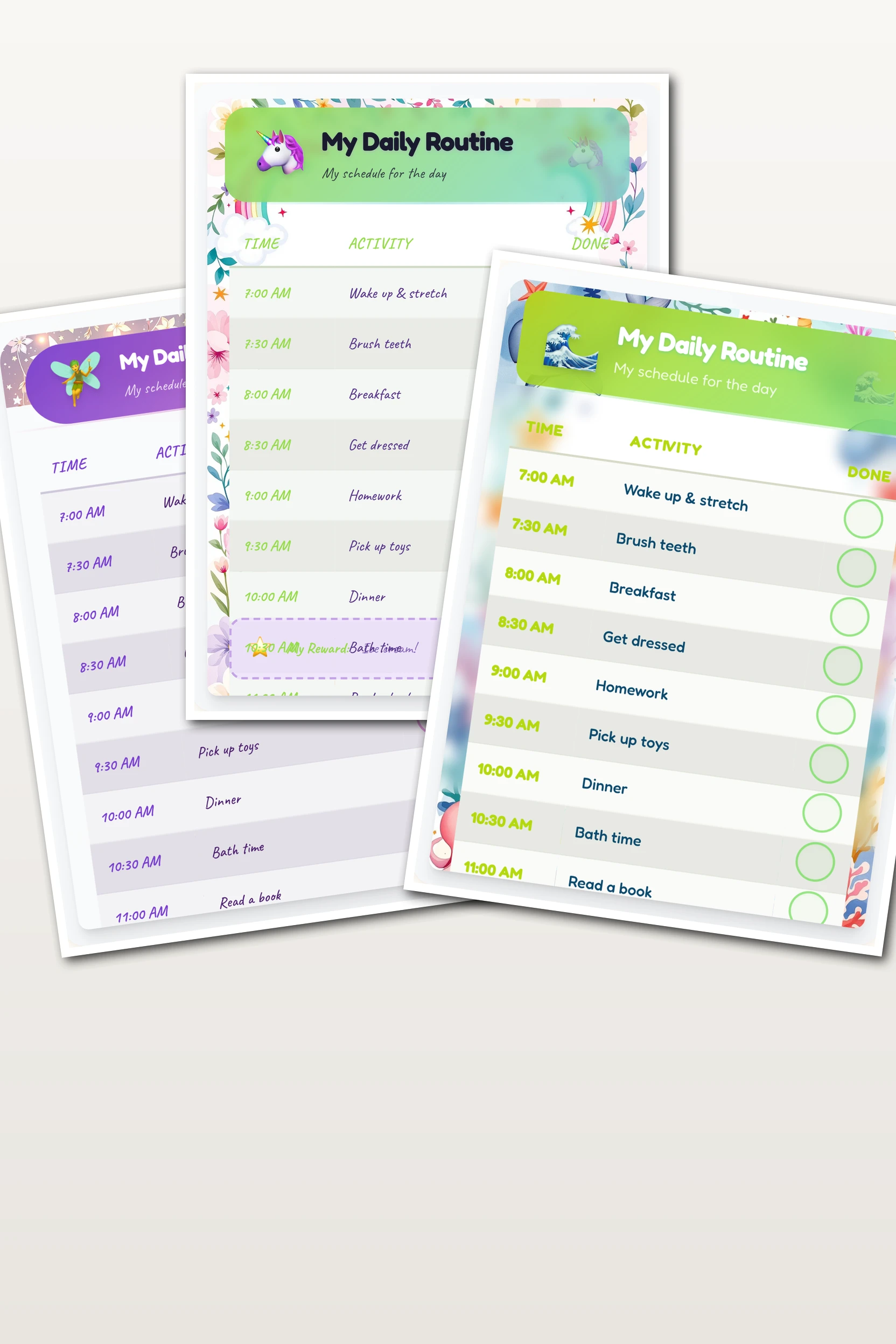
Serene Fairy Daily Routine
Serene Fairy Daily Routine — a watercolor style routine schedule with fairy theme. Unique colors and layout for kids.

Quiet Unicorn Time Planner
Quiet Unicorn Time Planner — a watercolor style routine schedule with unicorn theme. Unique colors and layout for kids.

Misty Ocean Daily Routine
Misty Ocean Daily Routine — a watercolor style routine schedule with ocean theme. Unique colors and layout for kids.
How to Use a Bedtime Routine Chart (So It Actually Sticks)
Plenty of parents have taped a bedtime chart to the bathroom wall and watched it be cheerfully ignored by day three. The difference between charts that get used and charts that gather dust almost always comes down to setup and ownership, not the chart itself.
Start with a conversation, not a presentation. Before introducing the chart, sit down with your child and talk through what bedtime currently feels like. Ask them what they wish went differently. Let them identify what they need — their own water bottle on the nightstand, a specific stuffed animal, the bathroom light left on. When kids see their input reflected in the chart, they feel invested rather than managed.
Laminate it and give them a marker. Physical interaction with the chart — actually checking off each step — engages the tactile and reward systems in the brain. The act of marking completion releases a small amount of dopamine, which reinforces the behavior over time. Laminated charts with dry-erase markers can be reset every night and survive the bathroom humidity. Some families use gold star stickers for younger children — the sticker ritual adds ceremony.
Post it at eye level in the right location. For most families, the bathroom mirror is the best spot because that's where teeth brushing and washing happen. A chart posted in the kitchen does nothing for a child standing in front of the sink. Match the chart's location to where the action starts.
Run it for two weeks before judging it. Habit formation research consistently shows it takes 14-21 days before a new routine stops feeling effortful and starts becoming automatic. Expect some pushback in the first week, especially from preschoolers testing the new system. Stay consistent, keep your tone calm, and let the chart be the rule-setter rather than making it a conversation. By week three, most children follow the chart without reminders.
Adjust as kids grow. A chart that works brilliantly for a five-year-old will feel babyish to a seven-year-old. Revisit the chart every six months and update it collaboratively. Older children can graduate from picture-based charts to simple checklists they create themselves in a notebook. The goal is lifelong healthy sleep habits, not permanent dependence on a piece of paper.
The 20-Minute Rule
For toddlers and preschoolers, the entire bedtime routine should take no longer than 20 minutes from start to lights out. For school-age children, 30 minutes is the upper limit. Routines that stretch past these windows tend to become negotiation sessions — kids sense your wavering energy and capitalize on it. Time your current routine once. If it's running 45 minutes or more, identify the two biggest time sinks and trim them first. A tighter routine is a calmer routine.
What Time Should Kids Go to Bed? Age Guide
| Age | Bedtime | Wake Time | Total Sleep Needed |
|---|---|---|---|
| 1–2 years (Toddler) | 6:30–7:30 PM | 6:00–7:00 AM | 11–14 hours |
| 3–5 years (Preschool) | 7:00–8:00 PM | 6:30–7:30 AM | 10–13 hours |
| 6–7 years (Early school) | 7:30–8:30 PM | 6:30–7:30 AM | 9–11 hours |
| 8–9 years (School-age) | 8:00–9:00 PM | 6:30–7:30 AM | 9–11 hours |
| 10–12 years (Tween) | 8:30–9:30 PM | 6:30–7:30 AM | 9–11 hours |
| 13+ years (Teen) | 9:00–10:00 PM | 7:00–8:00 AM | 8–10 hours |
Recommended sleep ranges from the American Academy of Sleep Medicine (AASM). Adjust by 30 minutes based on your child's individual sleep needs.
More Bedtime Charts by Theme

Kind Princess Flow Chart
Kind Princess Flow Chart — a watercolor style routine schedule with princess theme. Unique colors and layout for kids.
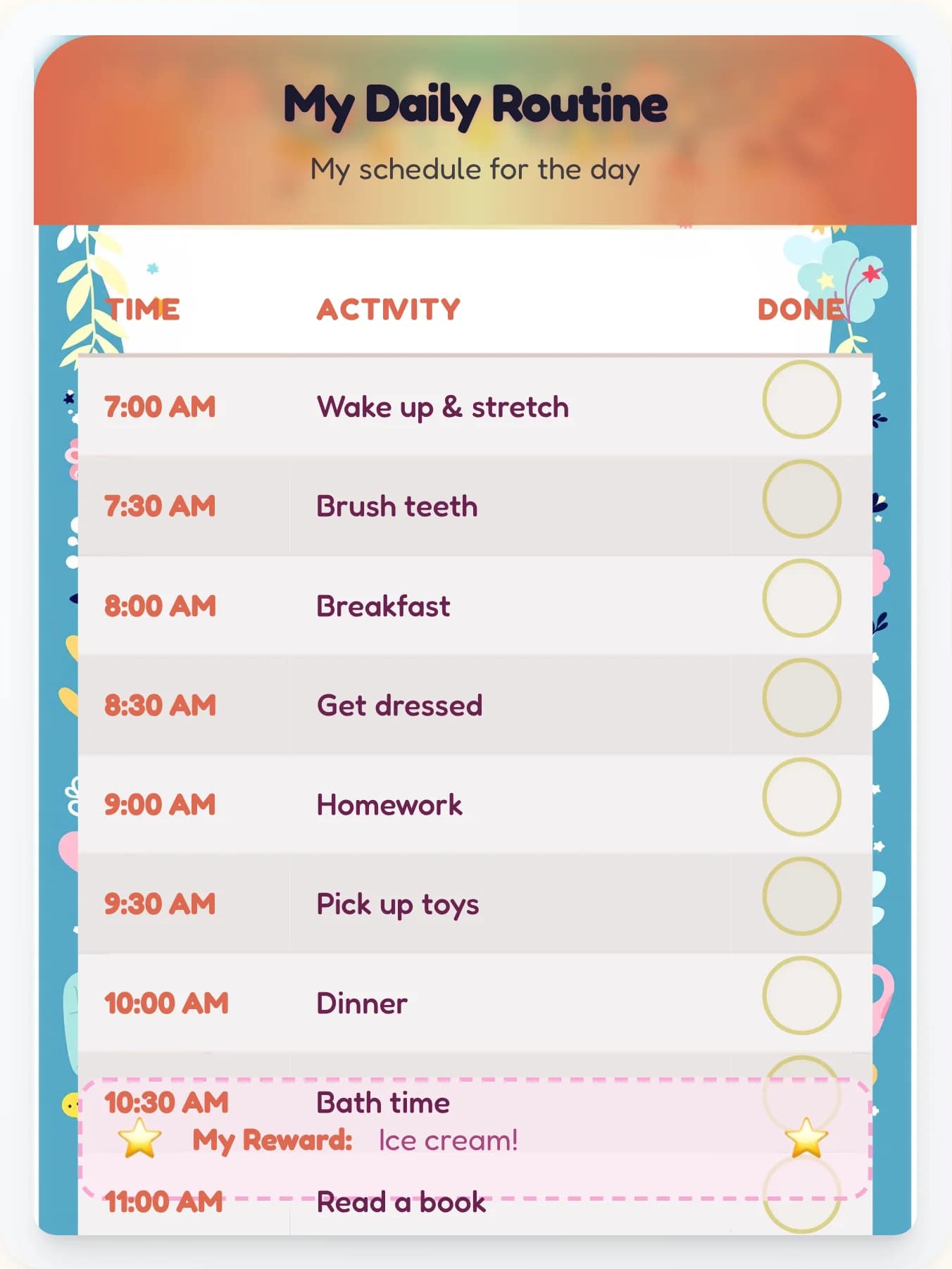
Cozy Kawaii Time Planner
Cozy Kawaii Time Planner — a 3d clay style routine schedule with kawaii theme. Unique colors and layout for kids.
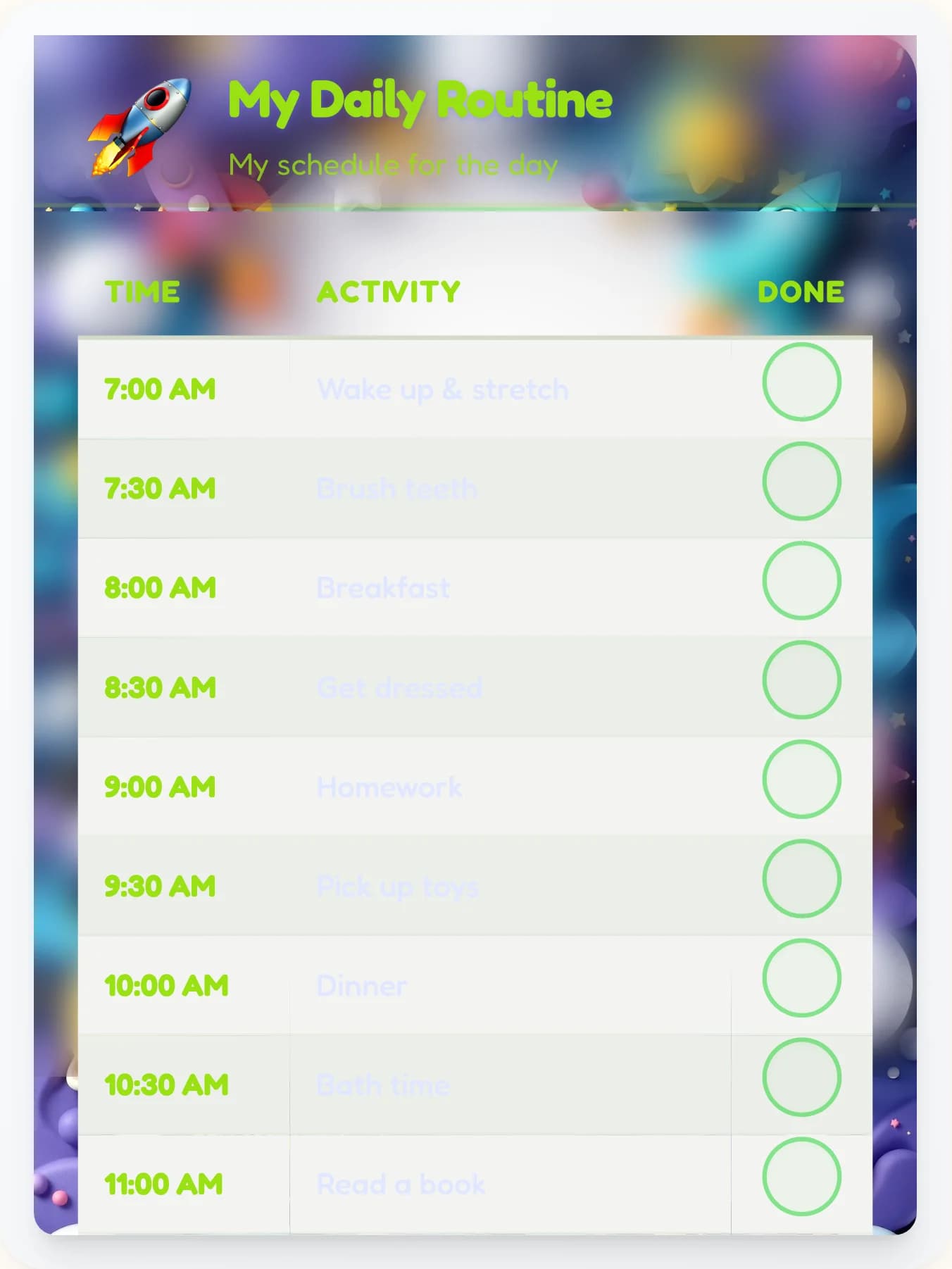
Playful Space Time Planner
Playful Space Time Planner — a illustrated style routine schedule with space theme. Unique colors and layout for kids.
Frequently Asked Questions About Bedtime Routine Charts
Key Takeaways
- Children with a consistent bedtime routine sleep 60+ minutes more per night — a compounding benefit that grows with each additional night of consistency
- Keep the routine short: 20 minutes maximum for toddlers and preschoolers, 30 minutes for school-age kids
- Involve kids in designing the chart — ownership eliminates most resistance
- Post the chart at eye level in the location where the routine begins, and use a dry-erase marker for nightly check-offs
- Allow 14-21 days before judging success — new habits take time to become automatic, and early pushback is normal