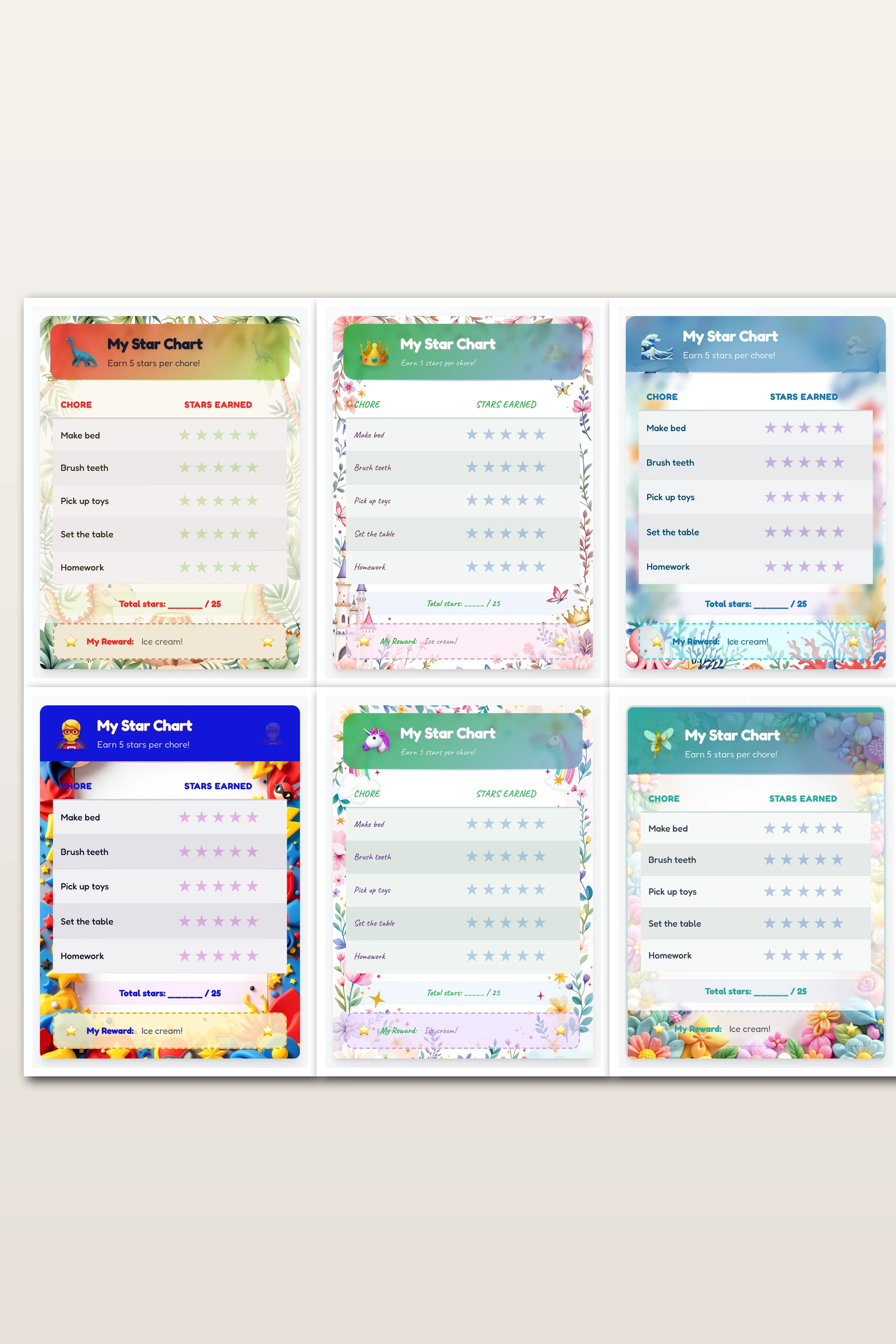
Star Charts for Kids: The Complete Guide to Sticker Reward Systems
The most popular chore chart format for young children — and how to use it right
Why Star Charts Are So Effective for Young Kids
Star charts work because they combine three things young children crave: immediate feedback, visual progress, and tangible rewards. When a child places a star sticker on their chart, they experience all three simultaneously — the act of sticking, seeing the chart fill up, and earning toward a goal.
The psychology is straightforward: children aged 2-7 are in the pre-operational stage of development. They think concretely, not abstractly. They cannot understand 'you will feel good about being responsible someday.' But they absolutely understand 'five stars equals choosing dessert tonight.'
Star charts are also brilliantly simple. There is no complex tracking, no weekly summaries, no percentages. Did you do the task? Star. Did you not? Empty space. Even a 2-year-old understands this binary system.
Star Chart vs Other Formats
| Feature | Star Chart | Weekly Grid | Daily Checklist |
|---|---|---|---|
| Best age | 2-7 | 5-12 | 3-10 |
| Visual appeal | Very high (stickers!) | Medium | Low-medium |
| Tracking type | Per-task stars | Day x task grid | Sequential list |
| Reward system | Built-in (fill the chart) | Separate | Separate |
| Complexity | Very simple | Moderate | Simple |
| Motivation type | Immediate, tangible | Pattern/streak | Completion satisfaction |
Setting Up a Star Chart That Works
- 1
Choose 3-5 target behaviors
Pick specific, observable tasks: 'brush teeth,' not 'be good.' Each task should take less than 5 minutes and happen at a predictable time each day.
- 2
Define the star rule clearly
The child earns a star immediately after completing the task — not at the end of the day. Delayed stars lose their power. Keep stickers accessible so the child can place them instantly.
- 3
Set a reasonable milestone
For ages 2-4: 5 stars = small reward. Ages 5-7: 10-15 stars = bigger reward. The milestone should be achievable within 2-3 days so the child experiences early success.
- 4
Let the child place the star
The physical act of peeling and placing the sticker is half the reward. Never place stars for them. Even if it takes 30 seconds of fumbling, that tactile experience is deeply satisfying.
- 5
Celebrate milestone achievements
When they hit the milestone, celebrate immediately. The reward should happen the same day if possible. Delayed rewards weaken the connection between effort and outcome.
Never Remove Stars
Once earned, a star stays. Never take stars away as punishment for bad behavior. Stars represent completed work — removing them teaches children that their effort can be erased, which destroys motivation. Discipline behavior separately from the star chart system.
When to Move Beyond Star Charts
Star charts are not forever. Most children naturally outgrow them between ages 7 and 9. Signs it is time to transition: they forget to place stars but still do the tasks, they stop caring about stickers, or they ask for a more grown-up system.
The transition should be gradual. Move from daily stars to a weekly check system. Replace stickers with checkmarks. Shift rewards from tangible prizes to privileges and experiences. The underlying structure stays the same — only the visual wrapper changes.
Some children hold onto star charts longer, especially if the theme is exciting (space stars, princess gems, dinosaur bones). That is perfectly fine. There is no wrong age to use a visual reward system if it still motivates.
Print a Star Chart Today
Star chart templates with themed designs — dinosaurs, princesses, space, and more. Free to print.
See Star Chart TemplatesTop Star Chart Templates
Rainbow Week
Bold rainbow rows where each chore has its own vibrant color
Funky Unicorn Schedule Chart
Funky Unicorn Schedule Chart — a illustrated style routine schedule with unicorn theme. Unique colors and layout for kids.
Squishy Puff Pals
Adorable 3D clay-sculpted kawaii animals bounce across a creamy pastel canvas in coral pink and butter yellow. Every row feels like a plush toy shelf with glossy rounded shapes and soft marshmallow glow.
Star Chart Questions
Key Takeaways
- Star charts are most effective for ages 2-7 due to immediate, tangible feedback
- Award stars immediately after task completion — never delay
- Set achievable milestones (5 stars for toddlers, 10-15 for school-age)
- Let the child physically place the star — the tactile experience matters
- Never remove earned stars as punishment
- Transition gradually to checkmark systems around ages 7-9