Family Chore Chart Systems: Fair Distribution for Every Age
When everyone contributes, no one resents — build a household system the whole family buys into
Why Individual Charts Aren't Enough
Individual chore charts work great for building personal responsibility. But they miss something important: household equity. When children only see their own tasks, they do not understand how the full household runs or how their contributions fit into the bigger picture.
A family chore system shows everyone's tasks side by side. It creates transparency, reduces 'that is not fair' complaints, and teaches children that a household runs because every member contributes. It also prevents the common scenario where one parent does 80% of the work while everyone else does the minimum.
The goal is not equal tasks — it is equitable contribution. A 5-year-old sets the table. A 10-year-old vacuums. A teenager cooks dinner. A parent handles finances. Different tasks, similar time commitment, visible to all.
Daily Time Contribution by Age
| Family Member | Daily Chore Time | Example Tasks |
|---|---|---|
| Ages 3-5 | 10-15 min | Set table, pick up toys, put clothes in hamper |
| Ages 6-9 | 20-30 min | Clear dishes, vacuum room, fold laundry |
| Ages 10-13 | 30-45 min | Cook simple meals, clean bathroom, do laundry |
| Ages 14-17 | 45-60 min | Cook dinner, deep clean, yard work |
| Adults | 60-90 min | Meal planning, shopping, finances, maintenance |
Building a Family Chore System
- 1
List every household task
Write down everything that keeps the household running — cooking, cleaning, laundry, dishes, trash, yard, pets, shopping, maintenance. Include invisible labor like meal planning and appointment scheduling.
- 2
Estimate time for each task
How many minutes per day or week does each task take? This creates objectivity. When a child says 'I do more than everyone,' the numbers tell the real story.
- 3
Sort by age-appropriateness
Divide tasks into columns: what 5-year-olds can do, 10-year-olds, teens, adults only. Some tasks have age minimums (sharp knives, oven), others are universal (tidying up).
- 4
Create the family board
Post a single chart showing all family members across the top and their assigned tasks below. Use a whiteboard, printable chart, or corkboard with task cards. Everyone sees everyone's contributions.
- 5
Hold weekly family meetings
Every Sunday, spend 10 minutes reviewing the week: what got done, what was missed, what needs adjusting. Let everyone have a voice. Rotate unpopular tasks monthly so no one is stuck with them permanently.
The Task Auction
Once a month, hold a family task auction. List all rotating chores and let family members bid on which ones they want. First picks go to whoever completed the most tasks last month. This gamifies the system and gives a real incentive for consistency.
Handling the 'Not Fair' Complaint
When a child says 'it is not fair that I have to do this,' there are two possible truths: either the distribution genuinely is unequal, or they are comparing without context. The family board solves both.
If the complaint is valid, adjust. If the child is doing 45 minutes and their sibling is doing 15, that needs fixing. The time estimates on the board make this objective.
If the complaint is perception, the board shows reality. 'Look — you do 20 minutes of chores, your brother does 25, and Mom does 75 minutes plus meal planning. Everyone is contributing.' Visibility creates fairness.
Print Charts for the Whole Family
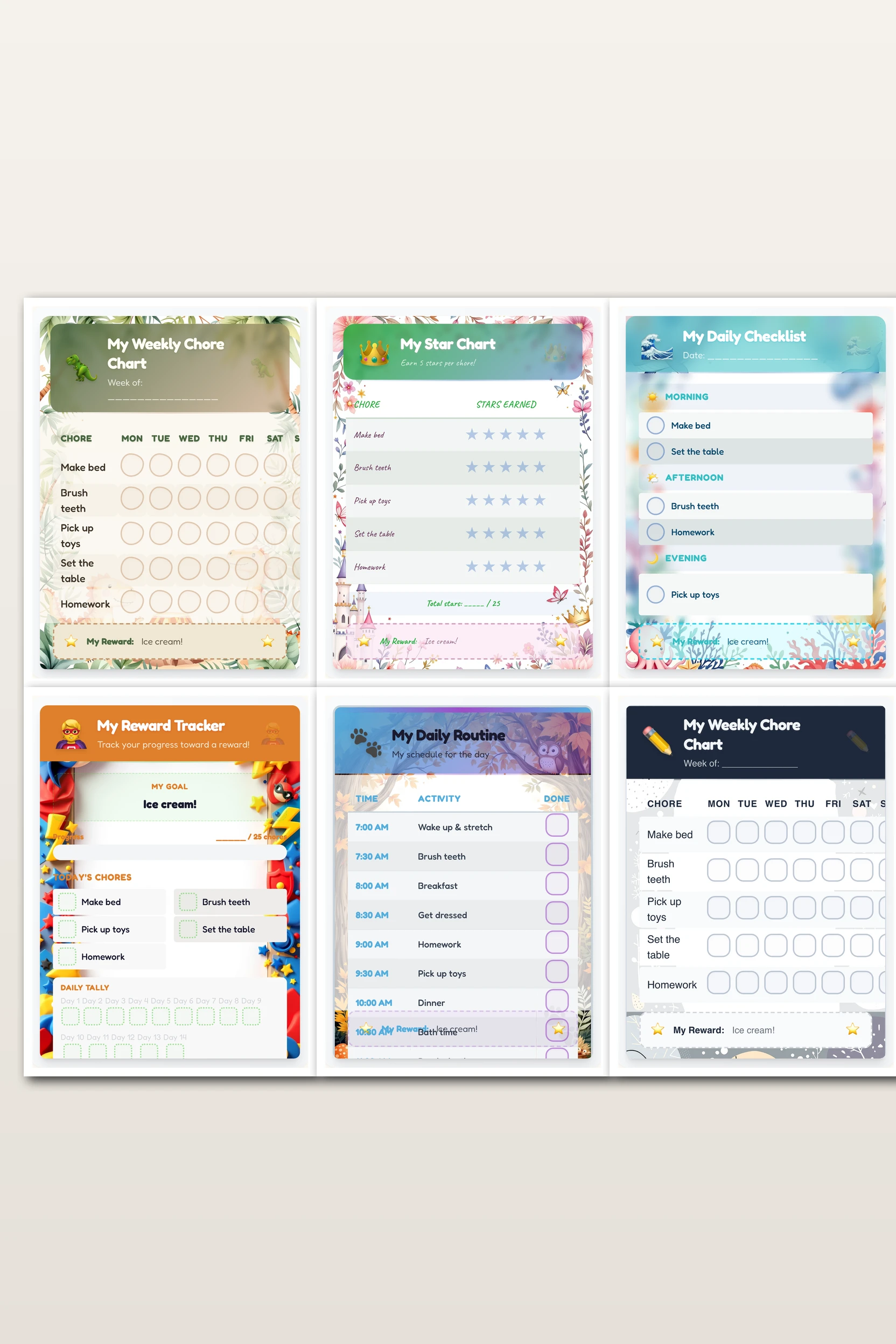
Multiple kids format, weekly grids, and daily checklists — one chart per family member or one for everyone
Browse Family TemplatesRecommended Chart Templates
Aqua Fins & Friends
Cool ocean watercolor border alive with tropical fish, playful turtles, and swirling seahorses in turquoise and seafoam tones. A refreshing underwater world frames this weekly chore chart for water-loving kids.
Autumn Woodland Tales
A warm storybook border of illustrated woodland animals — curious foxes, wise owls, hedgehogs among mushrooms, and fawns peeking through golden autumn leaves. Premium childrens book illustration quality with rich brushwork and autumnal charm.
Minimal Flat
Clean geometric borders with muted tones
Common Questions
Key Takeaways
- Family chore systems create transparency and reduce 'not fair' complaints
- Aim for equitable time contribution, not identical tasks
- Post one visible board showing all family members' contributions
- Hold 10-minute weekly family meetings to review and adjust
- Include parents on the chart to model the behavior
- Rotate unpopular tasks monthly so no one is stuck